
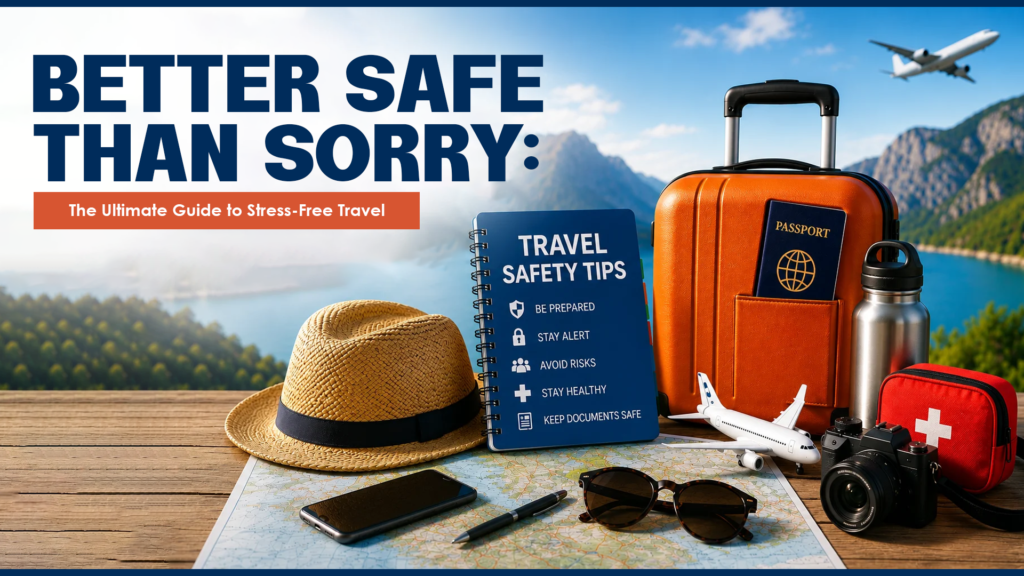
Travel is one of the best things you can do in life. It does not matter what type of trip you are planning. It could be a relaxing beach break, an international adventure, a family holiday, or a business trip. The main aim of travel is to enjoy new experiences and make wonderful memories. However, travel does not always go as planned. Sometimes, you may find yourself in a stressful situation.
A flight can be delayed, your luggage can go missing, or the weather can change at any time. You may also get sick or face a transport accident. The saying ‘better safe than sorry’ is very important when it comes to travel. It does not mean you should expect bad things to happen. It simply means making smart choices, knowing the risks, and taking simple steps before starting your journey.
Recent aviation events have also shown why awareness and preparation matter. Air travel is still one of the safest ways to travel. However, past plane crashes and recent accidents show why aircraft checks and repairs matter so much. They also show the need for good training, weather checks, and strong safety rules.
A great journey should be enjoyable from start to finish. Here are some good tips on Style Tendency to make your travels safer, better planned, and less stressful.
1. Plan Your Journey Before Leaving Home
A stress-free trip starts well before you get to the airport. Good planning prevents the last-minute panic and gives you much greater control over your trip.
Research your destination, including weather, transport, accommodation, local customs, safety, etc. Knowing what will happen next lets you prepare accordingly.
It is best to create a basic travel schedule that includes:
- Flight times, both departure and arrival.
- Hotel bookings and accommodation addresses.
- Airport transfers and local transport.
- Important tourist locations.
- Emergency contact information.
- Planned activities and estimated duration.
There is no need to plan every minute of your holiday. You can leave some free time for unexpected changes. Just make sure the main things are arranged. It is also a good idea to check your government’s travel advice before leaving. This will give you useful details about local safety, health risks, and natural disasters
2. Keep Your Travel Documents Safe and Organized
Travel documents are some of the most important things you carry. If you lose your passport, visa, boarding pass, or ID, it can cause big problems. This is even more difficult when you are traveling abroad. Before leaving, it is better to check that your passport is still valid. Some countries require your passport to stay valid for several months after your planned return date. Keep these documents ready:
- Passport and relevant visas.
- Flight tickets and boarding passes.
- Hotel booking confirmations.
- Travel insurance information.
- Driver’s license or International Driving Permit if required.
- Copies of important ID documents.
Keep digital copies in a safe cloud account or on a device with a password. Keep paper copies in a separate place from the original documents. Make sure you do not share pictures of your passport or boarding pass on social media. They may show private details that you do not want others to see.
Having all your travel documents ready also makes airport check in, immigration, and hotel registration much easier
3. Understand Air Travel Safety Before Booking
For many people, flying is still one of the quickest and easiest ways to get to a distant place. The problem is that when an aviation accident does occur, it gets massive media coverage, and that alone can make people anxious about flying. Understanding how aviation safety works will help put these concerns into context.
Commercial airlines are regulated to a high standard. Aircraft are inspected regularly; pilots are well trained, and air traffic controllers communicate constantly to keep aircraft well separated. When you are booking a flight, it’s worth considering the airline you are with. Choose one with a strong safety and operating record. Look at the regulatory oversight they have, the maintenance standards they follow, and their operating history.
Other useful precautions include:
- Book directly via the airline or via a reputable travel site.
- Review the airline’s baggage and passenger safety policies.
- Check whether your flight has convenient connections.
- Don’t book extremely tight connections.
- Follow the airline’s instructions throughout the journey.
Remember that flight delays and cancellations can be safety-related. An airline may obviously delay a flight for adverse weather, a technical inspection or for operational reasons. Although delays are of course annoying, it’s always far more important to allow the professionals to deal with the safety issues than it is to keep to a schedule.
4. Plane Crashes in History: Important Lessons for Travelers
Aviation history is full of tragic accidents that have shaped passenger safety as we know it today. Talking about those accidents is not about creating any kind of undue fear. It’s about understanding why the regulations, the technology, the training and the way we investigate are all still in a state of flux.
The Tenerife Airport Disaster (1977)
One of the most deadly aviation accidents in history took place on 27 March 1977 at Los Rodeos Airport, Tenerife, Spain.
Two 747s, one KLM, one Pan Am, collided on the runway during take-off. The incident resulted from several factors, including dense fog, airport congestion, a series of miscommunications and operational decisions. The accident was fatal, with 583 deaths.
The inquiry found serious issues with runway clearance, cockpit communication and coordination between the flight crews and ATC.
The safety lesson is clear communication and sticking to the procedures. Even the most experienced people must follow procedures rather than assume they know what to do.
Japan Airlines Flight 123 (1985)
On August 12th 1985, Japan Airlines Flight 123 crashed in a mountainous area in Japan following a catastrophic structural failure. The accident was due to an incorrectly repaired rear pressure bulkhead. The failure caused significant damage to the tail and hydraulic systems and severely affected the pilots’ ability to fly the aircraft.
A total of 520 people died and four survived. The inquiry highlighted the long-term impact of poor structural repair and the vital importance of accurate aircraft maintenance records.
The safety lesson is that aircraft maintenance is not just routine servicing. Proper investigation, qualified personnel and correct repair procedures are absolutely important to passenger safety.
Air France Flight 447 (2009)
Air France Flight 447 went missing over the Atlantic Ocean on the 1st of June 2009 en route from Rio de Janeiro to Paris. The A330 had issues with its airspeed sensors, which became blocked by ice crystals. The resulting incorrect airspeed readings contributed to the factors that led to the aircraft becoming uncontrolled.
All 228 on board died. The inquiry sparked significant discussion about pilot training, automated flight systems, situational awareness and managing unexpected technical problems.
The safety lesson is that aviation safety combines good technology, good pilot training and the ability to react appropriately in unexpected situations.
These incidents clearly show that aviation safety is constantly being improved through the process of investigation, the introduction of new procedures and the application of new technology.
5. Recent Aviation Incidents: Why Travel Awareness Matters
Recent aviation news has once again put passenger safety in the headlines. On 1st November 2026, a Learjet 60 crashed in Palm Beach County, Florida, while on the way from Austin, Texas, to North Eleuthera in the Bahamas. The accident caused the deaths of all nine people on board the aircraft.
According to initial reports from aviation authorities, the flight crew encountered icing, precipitation and moderate turbulence before calling an emergency and initiating a rapid descent.
The NTSB launched an investigation to determine what happened.
Early reports also had investigators considering the possibility that the aircraft broke up before impact. The investigation is still very much underway, and the cause has not yet been established.
Readers interested in the developing story can explore detailed coverage at Style Tendency in Learjet 60 Florida Crash: 9 Killed as Jet Falls in Palm Beach County.
This case shows how complicated aviation safety can be. Weather, aircraft systems, maintenance and the operational decisions that are made can all be areas of investigation. It’s vital not to draw conclusions until official investigators publish their verified findings.
For the passenger, the practical takeaway is simple: follow the airline’s safety instructions, stay up to date with travel information, and remember that the professional flight crew and aviation authorities are responsible for managing operational risks.
6. Always Wear Your Seatbelt During a Flight
One of the simplest and most important travel safety habits is to always wear your seatbelt when you are seated.
Many passengers think turbulence is only a problem in bad weather. Unexpected air movements are possible even when the sky’s perfectly clear. Turbulence can cause unsecured passengers to lose their balance or be thrown into the cabin surfaces.
The FAA recommends that you keep your seatbelt fastened at all times when you are seated, even when the seatbelt sign is off.
Here are a few useful precautions:
- Fasten your seatbelt low and securely across your hips.
- Keep it fastened whenever you’re sitting.
- Follow the flight attendants’ instructions.
- Don’t stand up unnecessarily during turbulent conditions.
- Secure any loose belongings and electronic equipment.
Parents traveling with young kids should also be aware of the airline’s approved child restraint requirements. A seatbelt is a minor precaution which can make a big difference in the event of some unexpected turbulence.
7. Purchase Travel Insurance Before Your Trip
Travel insurance is frequently missed when people are working out their holiday budget. It can offer useful financial protection in the event of unforeseen circumstances. Depending on the policy, travel insurance can cover medical emergencies, trip cancellations, travel delays, lost baggage and certain types of transportation disruption.
Before you go and buy the policy, take a good long look at the cover and the exclusions.
Pay particular attention to:
- Emergency medical treatment.
- Medical evacuation and repatriation.
- Trip interruption or cancellation.
- Lost, stolen or delayed baggage.
- Missed connections and qualifying travel delays.
- Emergency assistance services.
Don’t assume that every policy will cover every situation. Some policies exclude pre-existing medical conditions, adventure activities, extreme weather or specific locations. Compare providers and choose the cover that best suits your destination, length of travel, activities and individual circumstances.
For international trips, medical evacuation cover can be very useful as emergency transport can be very expensive.
8. Pack Smartly and Keep Essential Items Accessible
Overpacking can be a real pain. It makes traveling so much more exhausting, and you are far more likely to lose things. It also makes moving around an airport a nightmare. Instead, make a packing list based on where you are going, how long the trip is, the weather and what you are going to be doing.
Your essential carry-on bag should include:
- Travel documents and identification.
- Phone, charger and power bank.
- Prescription medication in its original pack.
- A small first-aid kit.
- Basic toiletries in accordance with airline restrictions.
- A change of clothes.
- Important contact information.
- Valuable personal belongings.
Don’t put your essential meds, your ID or any other irreplaceable items in your checked luggage. Remember the airline restrictions on liquids, batteries, sharp objects and the like. Always check your airline’s current baggage policy before you pack. A well-organized suitcase makes airport security, hotel check-in, and transport much easier.
9. Protect Your Health While Traveling
Travel will expose you to different climates, food, water and environments. Looking after your health is therefore important to a safe journey. Start by looking at any recommended vaccinations or health advice for your destination. If you have any particular medical requirements, you should speak to a doctor or other appropriately qualified health professional before you leave.
During the journey, follow a few simple habits:
Stay hydrated: Air travel, warm climates and a day of extra travel can all contribute to dehydration. Drink plenty of water throughout the day.
Eat carefully: choose food that’s been hygienically prepared, and follow local food safety advice.
Get good sleep. Sleep helps you to stay focused, energetic and generally well.
Take your medication with you: keep your essential meds to hand and check whether your destination has any restrictions on particular medications.
Keep yourself clean. Wash your hands regularly, particularly before you eat and after you have been on the bus, train, etc.
If you are traveling across several time zones, slowly adjusting your sleep schedule may help to reduce the effects of jet lag. Taking care of your body is vital so that you can enjoy your holiday without any health-related issues.
10. Research Your Destination’s Local Safety Conditions
Every destination has its own safety considerations. A place that’s perfectly fine for daytime travel may require different safety measures at night. Before you go, research the areas you will visit, local transport, emergency services and common tourist scams.
Consider these precautions:
- Use licensed taxis or trusted app-based services.
- Don’t show expensive jewelry or electronic items unnecessarily.
- Keep your belongings close to you in crowded public places.
- Stay alert to what is happening around you.
- Follow local laws and cultural rules.
- Don’t go into unfamiliar or poorly lit areas when you are alone
.
If you are visiting a country with different customs, learn a few basic local phrases. Knowing a few simple expressions about directions, transport, and emergencies can be a tremendous help.
You should also save the contact details of your country’s embassy or consulate where relevant. Being respectful, observant and informed goes a long way toward a safer, more enjoyable experience while you are traveling.
11. Keep Your Money and Personal Belongings Secure
Financial security is another key element of stress-free travel. Carrying large amounts of cash is generally unnecessary and can, in fact, increase the risk of it being stolen or lost accidentally. Instead, use a mix of cash, debit and credit cards. Divide your money between separate secure locations rather than having it all in one wallet.
Other useful practices include:
- Let your bank know if you are traveling internationally.
- Understand foreign transaction fees.
- Use secure ATMs in well-known, reputable locations.
- Don’t use unfamiliar public payment terminals.
- Open transaction notifications.
- Keep your emergency funds separate from your normal spending money.
For digital security, don’t connect to any unknown public Wi-Fi when you are accessing your bank accounts or any other sensitive information. A good VPN will add an extra layer of security when you’re on a public network.
You should also turn on your phone’s screen lock and turn on the device tracking features before you go. These simple measures will go a long way to protecting your finances and your personal details whilst you are on the move.
12. Prepare for Flight Delays, Cancellations, and Emergencies
Even the most carefully planned holiday can have its run of bad luck. Weather, technical checks, airport congestion and operational issues can all affect flight times. Rather than let these scenarios spoil your trip, plan for them in advance.
Keep your essentials in your hand luggage, i.e., your carry on, including medication, snacks, a charger and a change of clothes. Save your airline’s customer service details and download their official app to get flight alerts.
If your flight is delayed or canceled,
- Check the airline’s own channels.
- Contact the airline to find out what your options are.
- Ask about rebooking, accommodation and meal assistance where relevant.
- Keep your receipts for any expenses that may be eligible under your policy or passenger rights rules.
- Tell anyone who’s been waiting for you the new arrival time.
Passenger rights will vary depending on the airline, point of departure, point of arrival and the circumstances of the disruption. Having a backup plan reduces uneasiness and helps you react calmly if your travel plans change.
13. Make Family Travel Safer and More Comfortable
Traveling with the family obviously requires a bit more planning than just going on a trip alone. You have to take the children into account; you have to take the older people into account. Kids can get tired, restless or overwhelmed on long journeys. The older folk may need a bit more help with mobility, medication or with the airport stuff. A bit of preparation will make the whole thing a lot easier.
For families traveling with children:
- Keep snacks and water to hand.
- Pack some familiar toys or entertainment.
- Take any medication you may need and your ID.
- Explain the basic airport safety rules.
- Use the appropriate child restraint during transport.
- Establish a meeting point in the event that family members do get separated.
For older people, you can request airport mobility assistance in advance if needed. Choose accommodation that has good access to transport, to the hospital and to the other basics. It’s also useful to share the schedule with a trusted family member who isn’t traveling with you. The aim isn’t to control everything but to make sure people feel at ease, supported and prepared.
14. Stay Connected Without Compromising Digital Safety
Smartphones have made travel a lot easier. You have got your digital boarding passes, your navigation apps, etc. Technology has really made travel a lot easier. However, staying connected also demands sensible digital security practices. Before you go, download the offline maps for your destination and save the key travel info. Enable 2FA on your key accounts and don’t broadcast your real-time location.
Other helpful measures include:
- Keep your phone and apps up to date.
- Use strong passwords.
- Enable device location and device recovery features.
- Avoid unknown charging stations if at all possible.
- Use trusted Wi-Fi networks.
- Keep an alternative copy of your important travel information.
Consider buying a good local SIM or an international eSIM if you need a reliable internet connection. Having reliable connectivity makes it far easier to contact family and friends, to get directions and to get emergency alerts.
15. Create a Relaxed Travel Routine
Travel safety is important, but so is actually having a good time. You can get so caught up in the schedule, the photos, the bookings and the tour that you end up not enjoying it at all. A very relaxed travel plan makes a huge difference. Don’t overbook a day. Allow time for eating, time off, the unexpected, the discoveries and the inevitable delays in getting from A to B.
Get to the airport well in advance to allow plenty of time to check in and go through security. Have your travel documents to hand and double check your departure details before you leave your accommodation. Enjoy your holidays by doing the things you actually want to do rather than going through the motions of checking off every item on the ‘must see’ list.
Most importantly, an unplanned change doesn’t necessarily mean that the trip has gone tits up. A delayed train, a rainy afternoon or a change of plans for tourism are all small things in the context of an otherwise excellent day. The key to stress free travel is preparation and a certain amount of flexibility.
Travel Smart, Stay Prepared, and Enjoy Every Moment
Travel is not just about going somewhere new or experiencing a different culture. It is also about spending time with people you love and making memories that last a lifetime. However, an enjoyable journey does require some awareness and preparation.
Getting the right documents in place and buying the right travel insurance are essential steps. Understanding aviation safety is equally important. Protecting your own kit and taking these small precautions are best to make your experience as smooth as possible.
Historical aviation disasters and the more recent incidents serve as a constant reminder that safety should not be ignored. On the other hand, modern aviation is undoubtedly safer. This credit goes to improved regulations, better technology, better training for professionals and detailed accident investigations.
The best approach is not to be careless, and it’s not to let fear stop you from going at all. Instead, make sensible decisions, go with the professionals, prepare for the unforeseen and stay flexible as you go. Plan properly, go with confidence and make every journey count.
Frequently Asked Questions (FAQs)
1. What’s the best way to deal with travel anxiety prior to a long trip?
Work out what exactly it is that makes you anxious about flying, being in unfamiliar surroundings, being away from home, etc. Plan your itinerary, get there early, do some simple breathing exercises and don’t listen to the dreadful travel stories on the news. If the anxiety is so severe as to prevent you from traveling at all, then obviously you need to see a properly qualified mental health professional.
2. Should I report my international travel to my country’s embassy?
Some countries do have voluntary traveler registration schemes whereby you can register and, in that way, get emergency alerts. It also makes it much easier for consular staff to get in touch with you should a major incident occur. It’s worth checking whether your government has such a scheme in place prior to you traveling.
3. How can I reduce the environmental impact of my holiday?
Consider using public transport, choosing accommodation with sustainable practices in place, bringing your own water bottles, minimizing plastic use where possible, and, of course, supporting local businesses. Responsible travel is key to protecting the places we go to.
4. What should I do if I lose my smartphone while traveling abroad?
Use another device to locate or remotely lock your phone if the service is enabled. Get in touch with your mobile provider to suspend your SIM, change all your key account passwords and let your bank know if payment apps were accessible. Report the loss to the police where appropriate.
5. Is it better to travel during peak season or the off-season?
Both options have their merits. Peak season generally offers more to do and better tourist services, but at a higher price and with far more people. Off-season can be a good time to travel in terms of accommodation and getting better value, but you do have to bear in mind the weather and the fact that some attractions will be closed.
