
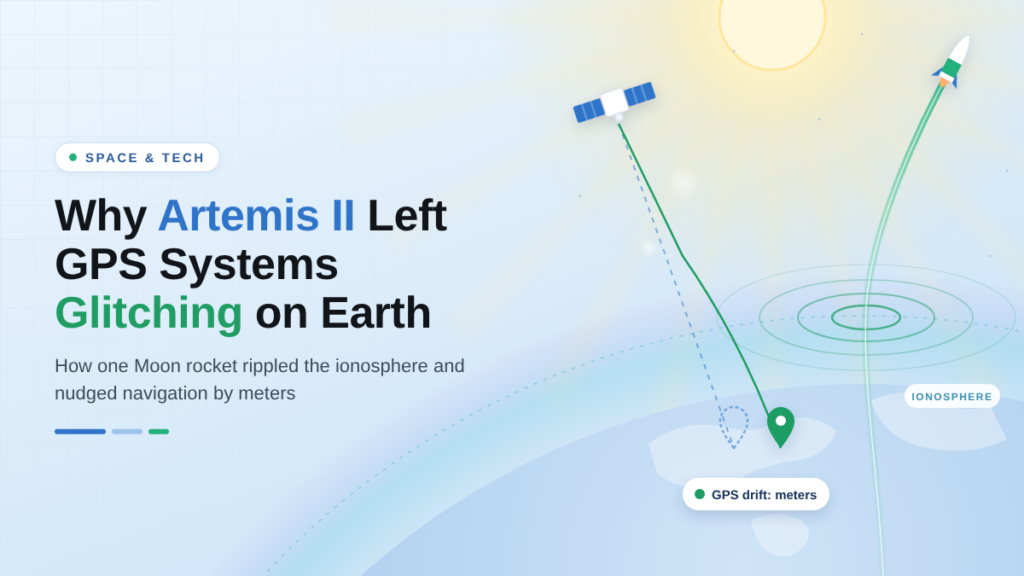
Artemis II left GPS systems glitching on Earth because NASA’s SLS rocket tore two giant holes in the ionosphere.
That charged layer of the upper atmosphere is exactly where GPS signals travel. When the rocket thinned it out the signals arrived off schedule and positions drifted by several meters.
At Style Tendency, we track these stories as they break so you get the latest updates first. Now let us dig into how a Moon rocket ended up nudging the blue dot on our phones.
Think back to April 2026. Many of us had the launch stream running on a laptop at work or a TV in the living room. We cheered as four astronauts lifted off for a trip around the Moon.
What we did not see was the invisible wake the rocket left behind. Long after the cameras cut away the upper atmosphere over the United States was still rippling.
Scientists in Taiwan later pieced that wake together. Their work shows that Artemis II launch effects on Earth reached far past the launch pad in Florida.
The Launch That Started It All
Artemis II lifted off on April 1 2026 from Kennedy Space Center. NASA’s Space Launch System carried the Orion capsule and four astronauts on a flyby of the Moon.
No crew had gone that far since the last Apollo mission more than 50 years ago. For a lot of us it was the first time we had seen anything like it live.
The mission had one big job. Prove that the rocket and the capsule could safely carry people to the Moon and back. That sets the stage for future landings.
It did that job. But it also did something nobody had on the checklist.
What researchers found afterward
A team from National Cheng Kung University in Taiwan studied ground station data from the launch. They found that the SLS had carved two huge disturbances into the ionosphere.
Each one stretched about 3100 miles or 5000 kilometers across the United States. That is longer than a nonstop flight from New York to Los Angeles.
Inside those zones the number of free electrons dropped and shifted. Since GPS signals pass straight through that layer the result was a brief wobble in positioning accuracy.
University of South Florida (USF): A seismology group deployed teams at the Kennedy Space Center during liftoff to capture rare seismic and infrasound wave data, measuring the physical impact of the SLS rocket blast on the Earth’s
The Artemis II Ionosphere Hole Explained
So how does a rocket put a hole in the sky? It helps to picture what the SLS was doing on its way up.
A rocket is not a jet. It does not cruise. It accelerates harder and harder as it climbs through layer after layer of air.
The Artemis 2 atmospheric shockwave
As the SLS pushed through the atmosphere it created powerful shock waves. These waves shoved the surrounding air and spread outward like ripples from a stone dropped in a lake.
Scientists call these ripples traveling ionospheric disturbances. They move across huge distances long after the rocket has passed.
At the same time the rocket’s exhaust reacted with the thin gas up high. That cleared out free electrons in certain spots. The result was a patch of the ionosphere with far fewer charged particles than normal.
That patch is what people mean by a NASA SLS rocket upper atmosphere hole.
Two holes and not one
The research team found two separate spacecraft ionospheric disturbances:
- The first came from the core stage. This 212 foot or 65 meter stage sent shock waves rippling out as it climbed.
- The second came from the upper stage. It fired its engine twice about 115 miles or 185 kilometers above Earth to send Orion toward the Moon.
Here is the twist. The second hole was the stronger of the two.
That makes sense once we think about it. The upper stage was firing right inside the ionosphere. It was like stirring a pot from the middle instead of tapping the side.
How Rocket Launch GPS Interference Works
To see why a hole in the ionosphere messes with GPS we need a quick look at how GPS finds us in the first place.
GPS is really a stopwatch
Every GPS satellite beams down a signal stamped with the exact time it was sent. Our phone or car does a simple job with it:
- It checks when the signal arrived.
- It works out how long the trip took.
- It turns that time into a distance.
- It repeats this with at least four satellites to lock in a position.
This only works if the signal travels at the speed the receiver expects.
Where the ionosphere gets in the way
The ionosphere begins about 30 miles or 50 kilometers up. It is full of free electrons that slow radio signals down a little. GPS receivers already expect a normal amount of delay and correct for it.
The trouble starts when that layer suddenly changes. A rocket thins it out in one spot and leaves ripples in another. Now the delay is not what the receiver expects.
The receiver does not know anything changed. It simply reads the wrong travel time and calculates the wrong distance. A delay of a few billionths of a second is enough to move our position by meters.
That is the whole chain in a nutshell. Rocket disturbs ionosphere. Ionosphere bends signal timing. Receiver gets a little lost.
What a Few Meters of GPS Glitching Really Means
For most of us a few meters is nothing. If our ride share app shows the car parked one house down we just walk a little farther.
But more and more machines make decisions on their own. For them a few meters can be the difference between right and wrong.
Self driving cars
Charles Lin is an Earth science professor at National Cheng Kung University and a coauthor of the study. He noted that errors of a couple of meters could affect decisions made by autonomous vehicles.
Imagine a driverless taxi heading home on a crowded freeway. It thinks it is in the middle lane. It is actually hugging the line next to the fast lane. When it plans a lane change that wrong starting point could make things messy.
The good news is that these cars do not lean on GPS alone. They also use cameras and radar and lidar and motion sensors. If GPS slips the other systems can usually keep the car on track.
Delivery drones
A drone dropping off a package needs to find one small patch of lawn. A few meters off could mean landing on a driveway or a neighbor’s roof. Like cars many drones carry backup sensors that help them hold steady.
Farms and surveyors
GPS guided tractors drive in tight straight lines to plant and spray. A drift of a few meters can mean seeds in the wrong row or fertilizer sprayed twice. Surveyors who map land and track ground movement also need readings they can trust.
Ships and planes
Boats and aircraft use satellite positioning for key navigation tasks. They have other tools too but accurate GPS makes everything smoother.
One thing we want to be clear about. The study found disturbances equal to several meters of error. It did not report any crashes or real failures tied to Artemis II. This was a measurable glitch and not a disaster.
Why the SLS Hit Harder Than Starship
This is the detail that surprised us most.
Some of the Artemis II disturbances were up to ten times stronger than those recorded after SpaceX Starship test launches. Yet Starship puts out roughly twice the liftoff thrust of the SLS.
More power should mean more disruption. So what is going on?
Location beats raw power
The researchers pointed to those upper stage burns. They happened high up and right inside the ionosphere. That put the disturbance exactly where GPS signals are most sensitive.
A simple way to picture it:
- A big launch at ground level is like a loud truck driving past your house. You hear it but the walls stay put.
- An engine burn inside the ionosphere is like someone rattling the window frame itself. It is quieter but it hits the thing that matters.
The takeaway for rocket fans is clear. To judge a launch’s effect on the atmosphere we have to follow the whole flight and not just the moment of liftoff.
How Scientists Caught the Glitch
The team did not need new satellites or fancy probes. They used tools that were already on the ground.
The United States is dotted with high precision GPS stations. Scientists normally use them to measure how the ground moves. They track tectonic plates and study shifts linked to earthquake risk.
These stations also record exactly how long satellite signals take to arrive. By comparing those times across the network the researchers could map changes in the ionosphere’s total electron content.
Step by step that let them rebuild the shape and size of both holes. Their findings were shared in a research preprint linked to the journal Geophysical Research Letters.
We find it pretty clever. A network built to watch the ground ended up watching the sky.
Are Rockets Worse Than Solar Storms?
No. The Sun is still the bigger troublemaker.
When the Sun throws out a burst of charged particles it can shake up the ionosphere across much of the planet. A strong solar storm can throw off GPS and radio for days at a time.
Rocket disturbances are much shorter. They fade as the atmosphere settles back down.
So why does Artemis II matter? Because it shows that people and not just the Sun can change the layer our signals travel through.
| Rocket launches | Solar storms | |
| Cause | Shock waves and engine burns | Charged particles from the Sun |
| What changes | Electron levels along the flight path | The ionosphere on a global scale |
| GPS effect | Errors of a few meters | Can cause large navigation errors |
| How long | Usually brief | Can last for days |
| Reach | Thousands of miles | Huge parts of the planet |
The Bigger Picture for Our Atmosphere
Artemis II is only the beginning. NASA wants astronauts back on the Moon and later on Mars. Private companies are racing to build their own heavy rockets.
That means the next few years could bring:
- More heavy rocket launches every year
- More engine burns high in the ionosphere
- Bigger batches of commercial satellites
- Crewed missions to the Moon and eventually Mars
- Busier launch calendars shared by many countries
Every one of those adds stress to the upper atmosphere. Research like this helps scientists build better GPS correction models. It also helps engineers design receivers that stay steady when the sky gets bumpy.
This is part of a larger question about how human activity shapes the world around us. We explored a related side of that in Can Renewable Energy Alone Power the World? Both stories come back to the same idea. Big progress always leaves a footprint and we need to understand it.
None of this means rockets should stay on the ground. It just means space travel and atmospheric science need to move forward together.
Frequently Asked Questions
Why did Artemis II cause GPS glitches on Earth?
The SLS rocket created two large holes in the ionosphere. GPS signals pass through that layer so the change threw off their timing and shifted positions by several meters. If you were confused by headlines about it you are not alone because it is a strange idea at first.
What is the Artemis II ionosphere hole?
It is a zone in the upper atmosphere where the rocket wiped out or shifted free electrons. One came from the core stage climbing and the other from upper stage burns about 115 miles up.
Did the GPS glitch cause any accidents?
No accidents were reported in the study. Researchers measured disturbances equal to a few meters of error but did not link them to any crashes. We know it can feel unsettling but this was a short blip and not a breakdown.
Can rocket launch GPS interference affect my phone?
It could nudge your location slightly for a short time. Most people would never notice it while walking or driving. Apps and phones also use WiFi and cell towers to help correct the position.
Will future rocket launches cause more GPS problems?
They might as launches get more frequent. Scientists are already using studies like this to improve GPS correction models. That work should help our devices stay accurate even as the sky gets busier.
Conclusion: A Moon Mission With an Earthly Side Effect
Artemis II gave us a moment many of us will never forget. Four astronauts headed around the Moon for the first time in half a century.
It also gave scientists a surprise. The SLS rocket left two massive holes in the ionosphere that spread across thousands of miles. Those holes changed the timing of GPS signals and could have pushed positions off by several meters.
Here is what we want you to remember:
- Artemis II left GPS systems glitching on Earth by disturbing the ionosphere.
- The upper stage burns caused a bigger effect than the launch itself.
- The SLS hit harder than Starship because of where it fired its engines.
- Self driving cars and drones face the most potential risk but backup sensors keep it low.
- Solar storms are still a far bigger threat to GPS than rockets.
The glitch was real but brief. It did not break GPS and it did not cause any reported accidents. What it did was remind us that every leap into space sends ripples back home.
As more rockets head for the Moon and Mars we will keep watching how they affect the sky above us. For the latest updates and simple explainers on space and science and the tech we use every day keep at Style Tendency.
